We’ve all had a Cheddar Bay biscuit—buttery, craggy, satisfying. But after several rounds of side-by-side testing in my own kitchen, I landed on a version that consistently beat the classic. The surprising part? The biggest improvements weren’t exotic ingredients. They came down to how the cheese was grated, which cheddars went in, and a buttery Parmesan glaze brushed on at the end.
The test that settled it
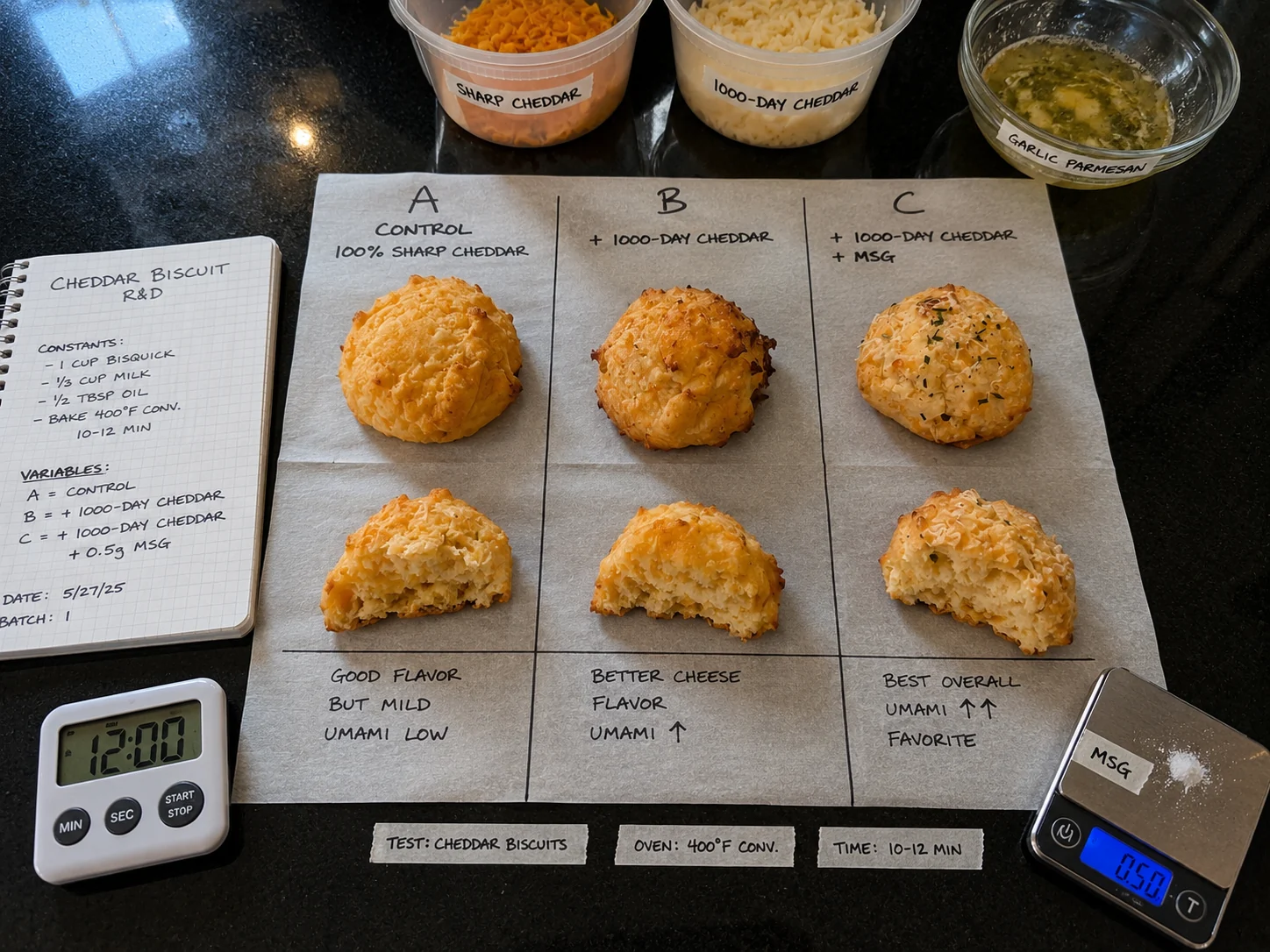
I ran three batches with the same base—1 cup Bisquick, ⅓ cup milk, ½ tablespoon oil, baked at 400°F convection for 10–12 minutes—and changed exactly one thing at a time:
- A — Control: 100% sharp cheddar. Good flavor, but mild. Umami low.
- B — + 1,000-day cheddar: a small amount of very aged white cheddar added to the sharp. Better cheese flavor. Umami up.
- C — + 1,000-day cheddar + 0.5 g MSG: the same blend, plus a tiny weighed dose of MSG. Best overall. Umami way up. The favorite.
Batch C won every time. The aged cheddar concentrates the savory notes, and the half-gram of MSG amplifies the glutamates already present in the cheese—no artificial taste, just more depth. The photo above is that exact bake-off, including the garlic-Parmesan butter waiting in the bowl up top.
The cheese I used
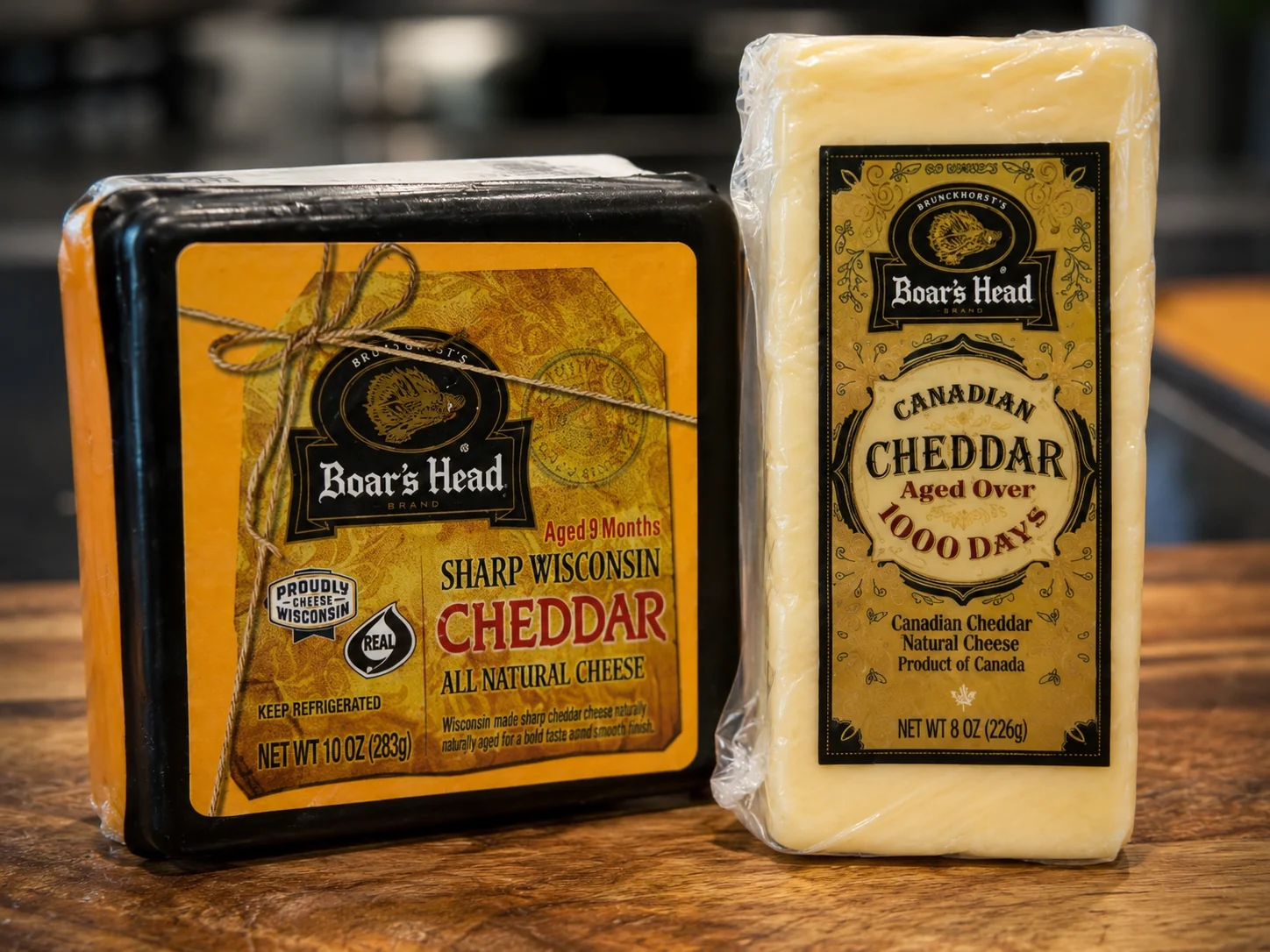
For every test batch I used these two specific cheddars:
- Yellow, sharp: Boar’s Head Sharp Wisconsin Cheddar, aged 9 months — the everyday melter that carries the classic, familiar cheddar flavor.
- White, aged: Boar’s Head Canadian Cheddar, aged over 1,000 days (roughly 2¾ years) — the umami booster that makes these biscuits taste like more than the sum of their parts.
You don’t have to buy these exact blocks—the recipe is forgiving and your favorite brands will work. But two things are non-negotiable if you want the same result:
- The yellow cheddar must actually be yellow cheddar. A real (annatto-colored) yellow sharp cheddar gives you the classic golden Cheddar Bay color and the familiar cheddar character. Don’t swap in a white cheddar here.
- The white cheddar must be aged at least 2 years. That long aging is where the concentrated, almost crystalline umami comes from. A young white cheddar simply can’t deliver it—this is the single ingredient doing the heavy lifting in the bake-off above.
A quick confession about the Bisquick
Yes—the foundation of this recipe is a box of Bisquick. In a pantry that also houses homemade shio koji, a jar of vinegar I cultured myself, and a wedge of cheddar I let age for the better part of three years, a cheery yellow box of pancake-and-baking mix looks gloriously out of place. So why is it there?
Because Bisquick is a solved problem. The flour, leavening, and shortening are already balanced and shelf-stable, which makes it the perfect control base for an experiment like this one. When every batch starts out identical, the only variable left is what I add—so I get to obsess over the cheese instead of re-tuning baking powder between rounds. Sometimes the smartest move in the kitchen is to let the food scientists at General Mills handle the boring part, so you can spend all your energy on the cheese pockets and the umami. I’m not above a shortcut when it makes the science cleaner—and the biscuits better.
Better Than Cheddar Bay Biscuits
Makes 8 biscuits
Biscuit Dough
- Original Bisquick baking mix — 2 cups (240 g)
- MSG — 0.5 g (about ⅛ teaspoon; weigh for best accuracy)
- Extra-sharp cheddar, shredded on the large holes of a box grater — 6 oz (170 g)
- Aged white cheddar (~1,000-day), shredded on the large holes of a box grater — 2 oz (57 g)
- Whole milk — ⅔ cup (160 g)
- Vegetable oil — 1 tablespoon (14 g)
Garlic Parmesan Butter
- Salted butter, melted — 3 tablespoons (42 g)
- Garlic powder — ¾ teaspoon (2 g)
- Dried parsley — ¾ teaspoon (0.5 g)
- Freshly microplaned Parmigiano-Reggiano — 2 tablespoons (10 g)
- Finely chopped fresh chives — 1 tablespoon (3 g)
- Kosher salt — a pinch (0.5 g)
Equipment
- Large-hole box grater
- Microplane (for the Parmesan only)
- Digital kitchen scale (recommended)
- Mixing bowl
- Parchment-lined baking sheet
- Wire cooling rack
Method
- Prepare the oven. Preheat a convection oven to 400°F and line a baking sheet with parchment.
- Prepare the cheese. Using the large holes of a box grater, shred the 6 oz extra-sharp cheddar and 2 oz aged white cheddar. Do not microplane the cheddar—larger shreds create pockets of melted cheese throughout the biscuit.
- Combine the dry ingredients and cheese first. In a large bowl, stir together the Bisquick, MSG, and both shredded cheddars until the cheese is evenly distributed and coated in the dry mix.
- Add the wet ingredients. Pour in the milk and oil and mix only until everything is evenly moistened. Do not overmix.
- Portion. Divide into 8 equal biscuits (about 75–80 g each if using a scale) and place on the sheet with about 2 inches between them.
- Bake. Bake at 400°F convection for 10–12 minutes, rotating the pan halfway if your oven runs hot. Bake until the center of the largest biscuit reaches 202°F on an instant-read thermometer, then remove from the oven.
- Make the butter. While the biscuits bake, whisk together the melted butter, garlic powder, dried parsley, microplaned Parmesan, chives, and a pinch of salt until smooth.
- Finish. Rest 2 minutes on the pan, then transfer to a wire rack and brush generously with the garlic-Parmesan butter while still hot. Let rest another 5 minutes before serving.
Notes
- Freshly grated cheese makes a dramatic difference in both texture and flavor.
- The aged cheddar boosts natural umami without overpowering the classic cheddar profile.
- Microplane only the Parmesan; use a box grater for the cheddar.
- Weighing the cheese produces much more consistent results than measuring by volume.
FAQ
Why use two different cheddars? The younger extra-sharp cheddar melts beautifully and provides the familiar cheddar flavor. The aged white cheddar contributes concentrated savory notes and natural umami. Together they create a richer cheese flavor than either cheese alone.
Why not use pre-shredded cheese? Pre-shredded cheese contains anti-caking agents that interfere with melting and prevent the cheese from forming rich pockets inside the biscuit.
Why a box grater instead of a Microplane? Large shreds stay intact during baking, creating pockets of melted cheese throughout. A Microplane turns cheddar into very fine particles that disperse into the dough instead.
Why add MSG? A very small amount of MSG enhances the naturally occurring glutamates already present in the aged cheese. It doesn’t make the biscuits taste artificial—it simply increases their savory depth.
Why put the Parmesan in the butter instead of the dough? Microplaned Parmigiano-Reggiano melts into the hot butter, coating the outside of the biscuit with concentrated umami. Keeping it out of the dough preserves the classic cheddar flavor while making every bite more flavorful.
Can I use a conventional oven? Yes. Bake at 425°F for about 12–13 minutes, checking for golden tops and lightly browned bottoms.
Can these be frozen? Yes. Freeze completely cooled biscuits in an airtight freezer bag for up to 3 months. Reheat from frozen in a 350°F oven for 10–12 minutes, then brush with a little fresh garlic butter before serving.
Final thoughts
Sometimes the best recipes come from testing rather than guessing. After multiple batches, the biggest improvements turned out to be surprisingly simple: grate the cheese correctly, use a blend of younger and well-aged cheddar, and finish with a buttery Parmesan glaze. The result is a biscuit that’s unmistakably inspired by Cheddar Bay—just a little richer, cheesier, and more savory.