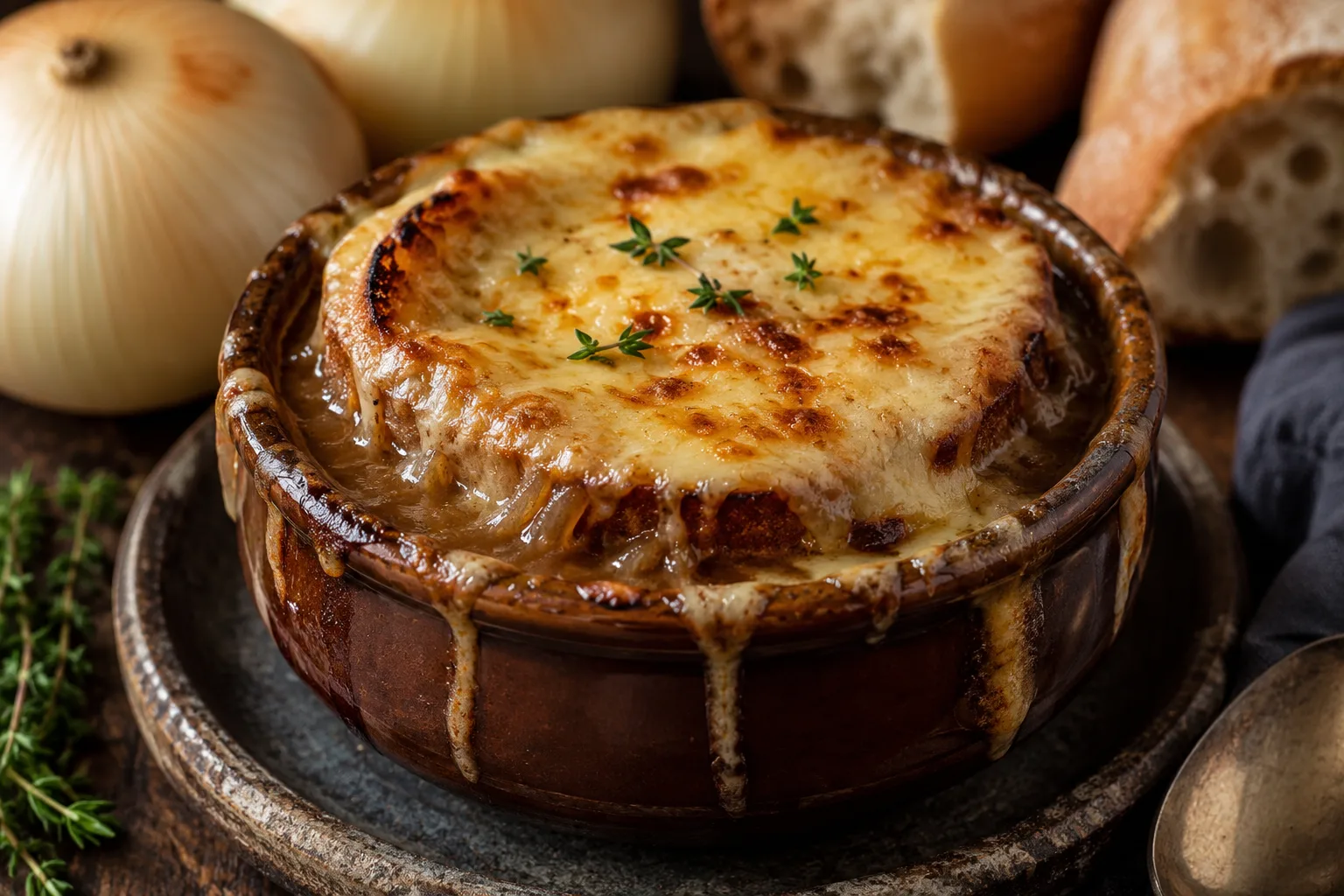
Soup French-Japanese Deeply Savory Vidalia French Onion Soup With Japanese Onion Tare

Deeply Savory Vidalia French Onion Soup With Japanese Onion Tare

Sweet Vidalia onions gain backbone from beef stock, dry sherry, and Japanese onion tare, producing a deeply savory French onion soup without the usual sugary heaviness.

Jump to Recipe

Somewhere along the way, “made with sweet Vidalia onions” turned into a bragging point, as if the goal of French onion soup were dessert. I’m not buying it. Vidalias are a genuinely great onion, but in this soup their sugar is a liability, not a virtue. Let it run unchecked and you get a bowl of soft, candied onions floating in salty broth — and somebody at the table will call that “depth.” It isn’t. It’s onion candy.

I came into this one with a head start: a batch of caramelized Vidalias I’d already cooked down low and slow, and a jar of Japanese-style onion tare I’d been quietly hoarding. (Yes, I’m the guy with onion tare on hand. My family stopped asking why a long time ago.) The whole job of this recipe is to take that sweetness and make it behave — dry sherry for acidity and nutty depth, real beef stock for backbone, and just enough vinegar to keep everything honest.

The tare is where this drifts happily away from the classic French version. It isn’t another jar of stuff thrown in to fake complexity — it does one specific job, and it does it cleanly.

Why the tare earns its place

Caramelizing onions builds hundreds of aromatic compounds, but sweetness on its own was never the same thing as complexity. The tare layers in a second wave of cooked-onion flavor, and its amino acids lean hard on the savory side of your palate — that glutamate-driven, mouth-filling sensation we’re all secretly chasing. That’s what lets the broth taste full and long without me reducing it into oblivion, thickening it with flour, or leaning on a stock so gelatinous it sets like aspic in the fridge. It’s also why there’s no salt in the ingredient list: between the tare, the stock, and two aged cheeses, the seasoning is already accounted for. Salt too early and you’ve painted yourself into a corner you can’t back out of.

The sherry isn’t a garnish

The dry sherry earns its half cup through chemistry, not nostalgia. Alcohol is a solvent — it grabs and carries aroma compounds that water simply can’t — and as the wine boils down it cooks off, leaving behind acidity and the oxidized, nutty flavors that make sherry taste like sherry. The order matters more than people think: pour the stock in before that raw alcohol has evaporated and you trap a blunt, boozy edge in the finished soup. Reduce it by half first, until the pot smells rounded and nutty instead of sharp, then build the broth on top of it.

The toast is structural, not decorative

That slab of bread isn’t just a raft for the cheese. Its real job is to hold the line between the molten cheese cap and the broth beneath it for as long as possible. Drying both sides hard under the broiler sets the starch into a rigid structure that drinks liquid in slowly — where a fresh slice surrenders on contact and drags your beautiful cheese down into the bowl as a soggy sponge. Toast it until it’s genuinely dry and deeply golden at the edges, a little further than feels comfortable.

Final thoughts

This is Vidalia onion soup with some discipline applied to it. The sweetness is still unmistakably there — I want you to know you’re eating Vidalias — but the tare, the sherry, the beef stock, and a hard-browned cheese crust drag it firmly back into the savory territory where French onion soup actually belongs.

Recipe

Prep: 15 min Cook: 35 min Total: 50 min Yield: 4 to 6 small bowls

Ingredients

Instructions

  1. Melt the butter in a heavy 4-quart pot over medium heat, add the prepared caramelized Vidalia onions, and cook for 5 minutes, stirring frequently, until bubbling and heated through.
  2. Add the dry sherry, scrape the bottom of the pot thoroughly, and boil for 4 to 6 minutes until the harsh alcohol aroma is gone and the liquid has reduced by roughly half.
  3. Add the beef stock, Japanese onion tare, and thyme; bring to a gentle simmer, then reduce the heat to maintain slow bubbling and cook uncovered for 20 minutes.
  4. Remove the thyme, stir in the apple cider vinegar and black pepper, and simmer for 2 minutes; the broth should taste intensely onion-forward, savory, and balanced rather than noticeably sweet or salty.
  5. Heat the broiler to high with a rack positioned about 6 inches below the element, arrange the baguette slices on a sheet pan, and broil for 1 to 2 minutes per side until dry and deeply golden at the edges.
  6. Divide the hot soup among 4 to 6 broiler-safe bowls, place one toast on each serving, and cover evenly with the Gruyere and Parmigiano-Reggiano.
  7. Set the bowls on a sheet pan and broil for 2 to 4 minutes until the cheese is fully melted, vigorously bubbling, and browned in scattered spots; rest for 3 minutes before serving because the bowls and soup will be extremely hot.

Notes

Vidalia onions contain enough sugar to make an onion soup taste flat or candied. Dry sherry and cider vinegar restore acidity and keep the sweetness in check.

The onion tare supplies salt, glutamates, and additional cooked-onion depth. Do not season the soup with extra salt until the tare and stock have simmered together.

Toast the bread until genuinely dry. Soft bread absorbs broth too quickly and turns the cheese topping into a wet sponge.

The soup base can be refrigerated for up to 4 days. Reheat it before adding the toast and cheese; do not store assembled gratins.

For a cleaner service, broil the cheese-topped toasts separately and float them on the soup immediately before serving.

TC
From the kitchen of Timothy Cunningham's Kitchen
Soup

Deeply Savory Vidalia French Onion Soup With Japanese Onion Tare

Sweet Vidalia onions gain backbone from beef stock, dry sherry, and Japanese onion tare, producing a deeply savory French onion soup without the usual sugary heaviness.

Published
July 3, 2026
Yield
4 to 6 small bowls
Course
Soup
Cuisine
French-Japanese

At a glance

Prep time15 min
Cook time35 min
Total time50 min

Ingredients

What you need

  • Soup: 2 tablespoons (28 g) unsalted butter
  • Soup: 4 cups (800 g) prepared caramelized Vidalia onions
  • Soup: 1/2 cup (120 g) dry sherry
  • Soup: 5 cups (1,200 g) unsalted or low-sodium beef stock
  • Soup: 1/3 cup (80 g) prepared Japanese Vidalia onion tare
  • Soup: 4 sprigs (4 g) fresh narrow-leaf French thyme, tied together
  • Soup: 2 teaspoons (10 g) apple cider vinegar
  • Soup: 1/2 teaspoon (1 g) freshly ground black pepper
  • Gratin: 6 slices (180 g) baguette, cut about 3/4 inch thick
  • Gratin: 1 1/2 cups (170 g) finely grated Gruyere cheese
  • Gratin: 1/3 cup (30 g) finely grated Parmigiano-Reggiano

Method

How to make it

  1. Melt the butter in a heavy 4-quart pot over medium heat, add the prepared caramelized Vidalia onions, and cook for 5 minutes, stirring frequently, until bubbling and heated through.
  2. Add the dry sherry, scrape the bottom of the pot thoroughly, and boil for 4 to 6 minutes until the harsh alcohol aroma is gone and the liquid has reduced by roughly half.
  3. Add the beef stock, Japanese onion tare, and thyme; bring to a gentle simmer, then reduce the heat to maintain slow bubbling and cook uncovered for 20 minutes.
  4. Remove the thyme, stir in the apple cider vinegar and black pepper, and simmer for 2 minutes; the broth should taste intensely onion-forward, savory, and balanced rather than noticeably sweet or salty.
  5. Heat the broiler to high with a rack positioned about 6 inches below the element, arrange the baguette slices on a sheet pan, and broil for 1 to 2 minutes per side until dry and deeply golden at the edges.
  6. Divide the hot soup among 4 to 6 broiler-safe bowls, place one toast on each serving, and cover evenly with the Gruyere and Parmigiano-Reggiano.
  7. Set the bowls on a sheet pan and broil for 2 to 4 minutes until the cheese is fully melted, vigorously bubbling, and browned in scattered spots; rest for 3 minutes before serving because the bowls and soup will be extremely hot.
Kitchen notes

Vidalia onions contain enough sugar to make an onion soup taste flat or candied. Dry sherry and cider vinegar restore acidity and keep the sweetness in check.

The onion tare supplies salt, glutamates, and additional cooked-onion depth. Do not season the soup with extra salt until the tare and stock have simmered together.

Toast the bread until genuinely dry. Soft bread absorbs broth too quickly and turns the cheese topping into a wet sponge.

The soup base can be refrigerated for up to 4 days. Reheat it before adding the toast and cheese; do not store assembled gratins.

For a cleaner service, broil the cheese-topped toasts separately and float them on the soup immediately before serving.

Frequently Asked Questions

Why use Japanese onion tare in French onion soup?

The tare concentrates cooked-onion flavor while contributing salt and glutamates. It reinforces the savory side of Vidalia onions, which otherwise can push the soup toward excessive sweetness.

Will Vidalia onions make the soup too sweet?

They can. The dry sherry, beef stock, and cider vinegar are not decorative additions; they provide bitterness, acidity, and savory depth that prevent the finished broth from tasting sugary.

Why is there no added salt in the ingredient list?

The onion tare, stock, Gruyere, and Parmigiano-Reggiano all contribute salt. Adding salt before they are combined would make the final seasoning difficult to control.

Can the soup be assembled ahead of time?

Prepare and refrigerate the soup base, toast, and grated cheese separately. Assemble only after the soup is reheated because bread left in the broth loses its structure.

Why use both Gruyere and Parmigiano-Reggiano?

Gruyere melts into an elastic, cohesive layer, while Parmigiano-Reggiano browns readily and adds concentrated savory flavor. Using only Parmesan would produce a drier, less unified crust.

How do I know when the sherry has reduced enough?

The liquid should decrease by about half, and the sharp smell of raw alcohol should disappear. The pot should smell rounded and nutty rather than boozy.

Can I broil the soup in ordinary cereal bowls?

No. Use bowls specifically rated for broiler heat. Ordinary ceramic can crack or fail under the intense direct heat of a broiler.