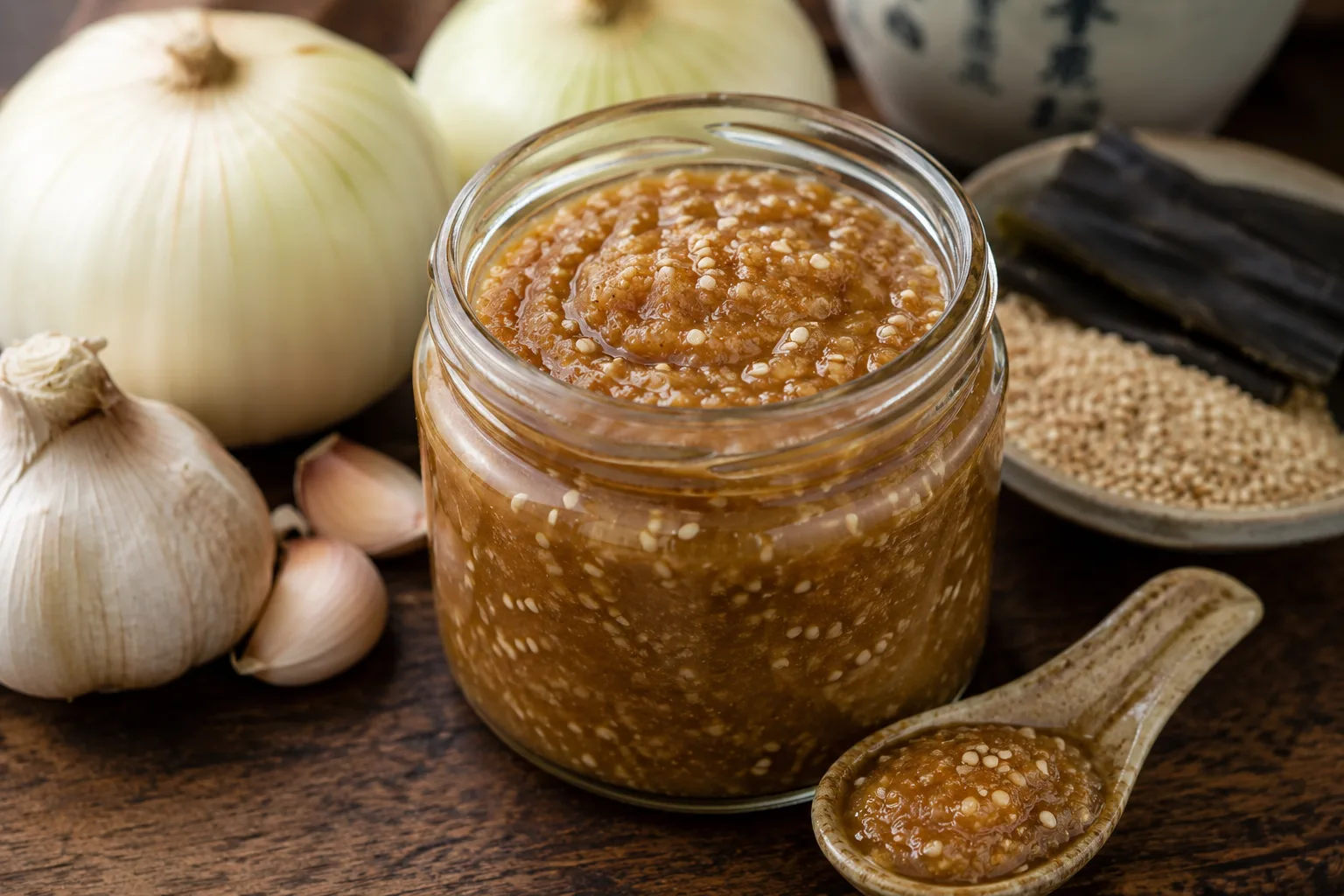
Sauce Japanese-American Vidalia Onion Tare With Shio Koji

Vidalia Onion Tare With Shio Koji

Vidalia onions, shio koji, kombu, soy, sake, and mirin become a concentrated onion seasoning built for soups, sauces, grilled meat, and rice bowls.

Jump to Recipe

I love a Vidalia, but let’s be honest about what it brings to the table: sugar, and not a whole lot of backbone. On its own, a Vidalia will never carry a tare — you’d end up with sweet onion baby food. So this one gets help. Shio koji, soy sauce, kombu, sake, and a shot of rice vinegar turn all that sweetness into a concentrated onion seasoning — something with salt, acid, and umami behind it, not a jar of puréed candy.

It starts by salting and draining the sliced onions, and no, that isn’t busywork. Pulling the free water out concentrates the onion before a single drop of seasoning goes in. That barely-there pinch of baking soda handles the other half of the job — it weakens the onion’s cell walls just enough for the koji to get to work. Measure the ⅛ teaspoon; eyeball it and you’re one heavy hand away from soap.

This is a koji cure, not a counter ferment

Here’s where people get it wrong. The five days in the fridge aren’t a wild, bubbling fermentation — they’re an enzymatic cure. The enzymes in my homemade shio koji spend those days quietly breaking the onions down while the cold keeps everything on a leash. The onions go soft, that raw sulfur bite fades, and the sweetness folds into the salt and amino acids from the koji.

Call it “fermented onion tare” if you like — it’s convenient shorthand — but the real mechanism is enzymatic breakdown under refrigeration. That’s not pedantry. It’s the reason this lives in the fridge and not on the counter: warm it up chasing “more fermentation” and you don’t get better tare, you get a less predictable one.

Why I season it in two passes

The first round of seasonings rides along for the entire five-day cure. Soy brings salt and glutamates, mirin rounds off the sweetness, sake adds aroma, rice vinegar keeps it honest with acidity, and the kombu quietly stacks on umami without ever tasting like the sea.

The garlic, the last of the soy and vinegar, and the sesame all go in after blending, because those are finishing notes. Cure them for five days and the garlic goes flat, the vinegar softens, and the toasted sesame aroma disappears into the background. Added at the end, they stay sharp and present.

Final thoughts

This tare earns its shelf in my fridge because it does more than salt a dish. It hands you onion body, acidity, sweetness, and umami in one measured spoonful — which is exactly why it gives my Vidalia French onion soup a depth that onions and stock alone can’t reach.

Recipe

Prep: 25 min Cook: 120 hr Total: 120 hr 25 min Yield: About 3 cups

Ingredients

Instructions

  1. Place the sliced Vidalia onions in a large nonreactive bowl, add the salt and baking soda, and massage for 1 minute until the slices begin to soften and glisten.
  2. Let the onions stand at room temperature for 30 minutes, stirring once halfway through, until they release a substantial pool of liquid.
  3. Transfer the onions to a colander and drain for 10 minutes without rinsing; press lightly with clean hands, but do not squeeze them dry.
  4. Pack the drained onions into a clean nonreactive container and add the shio koji and kombu.
  5. Whisk together the water, 1/3 cup soy sauce, mirin, sake, and 2 tablespoons rice vinegar, then pour the mixture over the onions and stir thoroughly.
  6. Cover and refrigerate for 5 days at 34 to 40°F, stirring once daily so the onions remain evenly coated; the onions should become very soft, savory, and noticeably less sharp.
  7. Remove and discard the kombu, then blend the onion mixture directly in the container with an immersion blender until smooth.
  8. Add the garlic, remaining 2 tablespoons soy sauce, remaining 1 tablespoon rice vinegar, and toasted sesame seeds, then blend briefly until incorporated but the sesame remains faintly visible.
  9. Transfer the tare to clean jars and refrigerate for at least 12 hours before using so the raw garlic mellows and the seasoning becomes integrated.

Notes

This is a standardized reconstruction of the original batch. The onion, shio koji, garlic, kombu, five-day refrigerator cure, and finishing method are preserved; the unrecorded liquid seasonings have been fixed at repeatable amounts.

Baking soda weakens onion cell walls and speeds moisture release, but excess will create a soapy flavor. Measure the 1/8 teaspoon rather than estimating it.

The five-day rest is primarily an enzymatic koji cure, not an uncontrolled room-temperature fermentation. Keep the onions refrigerated throughout.

Use the tare as both seasoning and body. Stir it into broth, pan sauces, marinades, braises, fried rice, or grilled-meat glazes rather than treating it like a thin dipping sauce.

Keep refrigerated in a clean, tightly closed jar and use within 3 weeks. Freeze in small portions for longer storage.

TC
From the kitchen of Timothy Cunningham's Kitchen
Sauce

Vidalia Onion Tare With Shio Koji

Vidalia onions, shio koji, kombu, soy, sake, and mirin become a concentrated onion seasoning built for soups, sauces, grilled meat, and rice bowls.

Published
July 3, 2026
Yield
About 3 cups
Course
Sauce
Cuisine
Japanese-American

At a glance

Prep time25 min
Cook time120 hr
Total time120 hr 25 min

Ingredients

What you need

  • Onion cure: 2 pounds (907 g) Vidalia onions, peeled, halved, and thinly sliced
  • Onion cure: 1 teaspoon (6 g) fine salt
  • Onion cure: 1/8 teaspoon (0.6 g) baking soda
  • Koji seasoning: 1/2 cup (120 g) homemade shio koji
  • Koji seasoning: 1-inch square (3 g) dried kombu
  • Koji seasoning: 1/2 cup (120 g) water
  • Koji seasoning: 1/3 cup (80 g) Japanese soy sauce
  • Koji seasoning: 1/4 cup (60 g) mirin
  • Koji seasoning: 1/4 cup (60 g) sake
  • Koji seasoning: 2 tablespoons (30 g) unseasoned rice vinegar
  • Finishing: 3 medium cloves (15 g) raw garlic, finely grated
  • Finishing: 2 tablespoons (30 g) Japanese soy sauce
  • Finishing: 1 tablespoon (15 g) unseasoned rice vinegar
  • Finishing: 1 tablespoon (9 g) toasted sesame seeds

Method

How to make it

  1. Place the sliced Vidalia onions in a large nonreactive bowl, add the salt and baking soda, and massage for 1 minute until the slices begin to soften and glisten.
  2. Let the onions stand at room temperature for 30 minutes, stirring once halfway through, until they release a substantial pool of liquid.
  3. Transfer the onions to a colander and drain for 10 minutes without rinsing; press lightly with clean hands, but do not squeeze them dry.
  4. Pack the drained onions into a clean nonreactive container and add the shio koji and kombu.
  5. Whisk together the water, 1/3 cup soy sauce, mirin, sake, and 2 tablespoons rice vinegar, then pour the mixture over the onions and stir thoroughly.
  6. Cover and refrigerate for 5 days at 34 to 40°F, stirring once daily so the onions remain evenly coated; the onions should become very soft, savory, and noticeably less sharp.
  7. Remove and discard the kombu, then blend the onion mixture directly in the container with an immersion blender until smooth.
  8. Add the garlic, remaining 2 tablespoons soy sauce, remaining 1 tablespoon rice vinegar, and toasted sesame seeds, then blend briefly until incorporated but the sesame remains faintly visible.
  9. Transfer the tare to clean jars and refrigerate for at least 12 hours before using so the raw garlic mellows and the seasoning becomes integrated.
Kitchen notes

This is a standardized reconstruction of the original batch. The onion, shio koji, garlic, kombu, five-day refrigerator cure, and finishing method are preserved; the unrecorded liquid seasonings have been fixed at repeatable amounts.

Baking soda weakens onion cell walls and speeds moisture release, but excess will create a soapy flavor. Measure the 1/8 teaspoon rather than estimating it.

The five-day rest is primarily an enzymatic koji cure, not an uncontrolled room-temperature fermentation. Keep the onions refrigerated throughout.

Use the tare as both seasoning and body. Stir it into broth, pan sauces, marinades, braises, fried rice, or grilled-meat glazes rather than treating it like a thin dipping sauce.

Keep refrigerated in a clean, tightly closed jar and use within 3 weeks. Freeze in small portions for longer storage.

Frequently Asked Questions

Why salt and drain the Vidalia onions before adding the seasonings?

Salt draws out free onion water, while the small amount of baking soda softens the cell structure. Draining that liquid prevents the finished tare from becoming weak, watery, and excessively sweet.

Does the baking soda caramelize the onions?

No. There is no browning step here. The alkaline baking soda accelerates onion breakdown and changes texture, but caramelization requires substantially more heat than this refrigerated preparation receives.

What does shio koji contribute to the tare?

Shio koji supplies salt, sweetness, savory amino acids, and active enzymes. During the refrigerated rest, those enzymes help soften the onions and develop a rounder flavor than soy sauce alone would provide.

Why is the kombu removed before blending?

Kombu releases glutamates during the five-day rest, but blending the seaweed into the sauce can create a slippery texture and an overly marine flavor.

Can I leave out the sake?

The sake contributes aroma and balances the sweetness of the Vidalia onions and mirin. Replacing it with more water will make the tare flatter, though the mixture will still function.

Why add the garlic after the five-day cure?

Fresh garlic added at the end retains a sharper aroma and gives the blended tare definition. Garlic added at the beginning would become softer and less distinct during the long rest.

How should I use this in French onion soup?

Begin with about 1 tablespoon per cup of unsalted or low-sodium broth, simmer the soup, and adjust only after tasting. The tare already contains shio koji and soy sauce, so additional salt may be unnecessary.